
 416-962-1010


BREAST IMPLANT REVISION AT POWER PLASTIC SURGERY
Are you considering breast implant revision? Perhaps you have a desire to change the size of your implants or have concerns about your results from previous augmentation. No matter the reason, Dr. Power can help you to achieve the look that is right for you! Our team uses leading techniques and equipment to help you achieve your aesthetic goals.
What is Breast Implant Revsion?
Breast implant revision, also called breast augmentation revision, is performed to modify the outcome of previous breast augmentation surgery. It may involve implant exchange – replacing your original implants with new ones of a different size and/or type – or to address complications of previous surgery. This may involve releasing or removing scar tissue around the implants, repositioning, or adjusting the implant pockets. Breast implant revision may be performed in combination with a breast lift. In other cases, patients may wish to undergo removal of breast implants.
There are many reasons why a patient may wish to undergo breast implant revision. These may include:
- Capsular Contracture: This develops when the scar tissue surrounding an implant – which is referred to as the capsule – tightens over time. In mild cases, there are no symptoms or changes in appearance. As the scar tissue becomes tighter, this may change the appearance of your implant and become painful in advanced cases. Your implant may feel quite firm and appear high on your chest wall.
- Asymmetry: Implants may heal or settle differently between sides. This may also relate to surgical technique if the pockets were created with different dimensions during your original surgery.
- Implant Rupture or Leakage: When the silicone shell of an implant tears or breaks apart, it is called a rupture. Imaging is generally required to detect rupture of a silicone implant, particularly of the “gummy bear” or cohesive gel implants. It may be noted on mammogram, ultrasound, or MRI. A saline implant deflates when ruptured, which is most commonly noticeable without imaging given change in breast appearance.
- Wrinkling/Rippling: This is seen more often in thin patients, particularly with saline as opposed to silicone implants. Large implants also carry higher risk of wrinkling and rippling in the long-term since they may cause thinning of the overlying skin and breast tissue. Implants placed above the muscle in the subglandular pocket are also at greater risk for rippling.
- Shifting of Implant: Over time implants may shift from their original position. They may migrate more towards the sides extending under the arms or lower on the chest wall related to gravity. It is important to wear a supportive bra in the long-term to lower risk of implant shifting and malposition.
Revision surgery will be based on your specific concerns and appearance. Options may include capsulotomy (scar tissue release), capsulectomy (scar tissue removal), capsulorrhaphy (tightening or resuspending the capsule to alter implant position), or implant exchange to a different size, type, or placement.
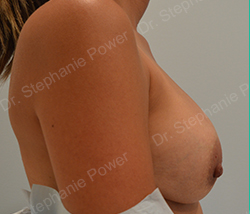
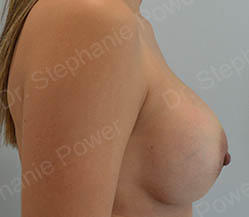
How is Breast Implant Revision Performed?
Breast implant revision is performed under general anesthesia and usually takes about 2-4 hours, depending on the extent of surgery. When performing this procedure, Dr. Power most commonly recommends an inframammary approach, using incisions hidden within the breast folds. It is generally not recommended to exchange implants through an axillary (underarm) incision, given limited exposure. If your primary breast augmentation was performed using periareolar incisions – along the lower border of the areola – it is not recommended to use the same scars given risk of developing nipple retraction. This may lead to a tethered appearance of the nipple due to increased scar tissue. During breast implant revision, implants will then be placed above or below the muscle depending on your original implant placement and what is determined to be the best choice for you. The existing implant pockets will be modified to ensure implants can move naturally. Patients can choose between saline or silicone gel implants, depending on your personal preference and clinical examination. In cases where a breast lift is also being performed, Dr. Power will remove loose breast skin then reposition and lift your breasts to a more youthful position. Incisions will be closed with dissolvable sutures.

Who is a Good Candidate for Breast Implant Revision?
You may be a candidate for breast revision surgery if you wish to improve upon results from previous breast augmentation. Your implants may have dropped over time due to changes during pregnancies, breastfeeding, or weight fluctuation. Your preferences may have changed relating to implant size or position. Your concerns may also relate to capsular contracture, which results in varying degrees of scar tissue surrounding the implant. This may range from a somewhat tight implant to one that is high on your chest wall and painful. If you are considering breast implant revision, it is generally the safest recommendation to defer surgery until you have completed pregnancies and breastfeeding and have achieved a stable and healthy BMI. Smoking cessation is also important to lower risk of healing complications.
Breast Implant Revision Recovery
Recovery from breast implant revision surgery is similar to what you experienced following your primary breast augmentation. Implant revision surgery is performed as an out-patient procedure. A surgical bra is recommended to be worn full-time except when showering over the first 6 weeks. Mild to moderate discomfort can be alleviated by prescribed pain medication and by performing cold compresses over the first 48 hours. Patients are generally able to return to work within one week if their work is not physically strenuous. Avoid strenuous activity and heavy lifting for the first month. Light cardio can resume at one month, and full activity, including upper body workouts, at 6 weeks. Dr. Power will give you specific instructions on when you can safely return to rigorous exercise, including lifting/straining, physical labor, sex, and other daily activities.
Breast Implant Revision Before and After Photos
Real patients of Dr. Power, from our photo gallery. Every body is different, and your results will depend on your anatomy and goals.
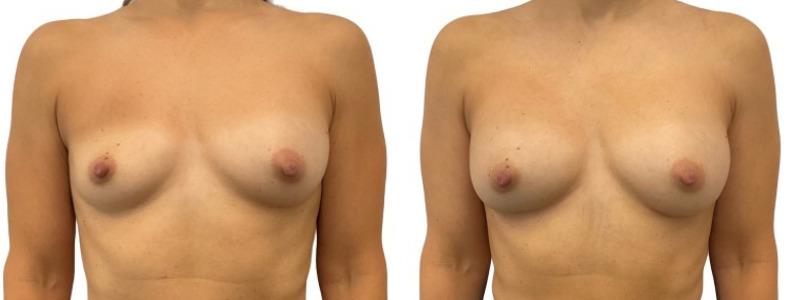
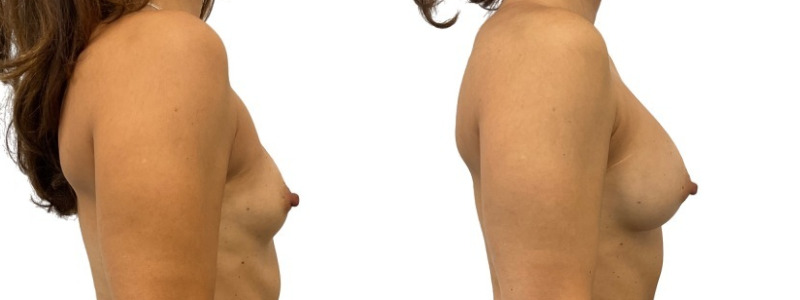
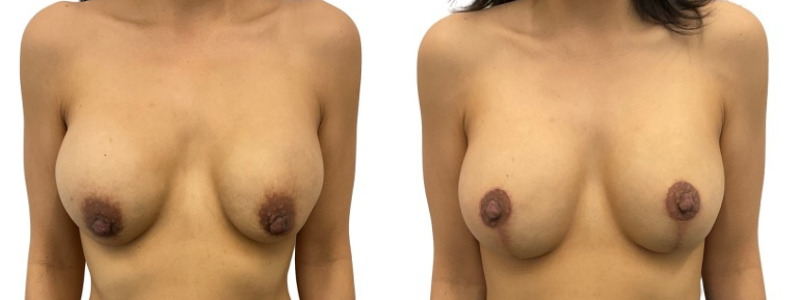
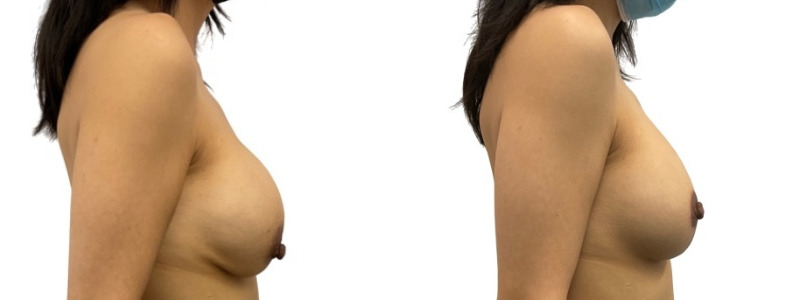
Individual results vary.
Breast Implant Revision Cost in Toronto
Fees depend on the extent of surgery and whether new implants are needed. Our starting fees:
Breast implant revision
from $12,380
Under general anesthesia
Bilateral implant exchange
from $13,640
Replacing existing implants
Breast implant removal
from $7,040
Removal without replacement
Prices shown are starting fees. Your personalized quote itemizes the fees that apply to your surgery, such as the surgeon fee, anesthesia, facility and nursing fees, supplies and HST. Quotes are valid for 6 months. A non-refundable 25% deposit secures your surgery date, and the balance is due 3 weeks before surgery. Monthly payment plans are available through Beautifi financing.
Breast Implant Revision Recovery Timeline
Recovery is similar to your original breast augmentation. You will receive written instructions, and your plan is tailored to you.
- Day of surgeryRevision is done under general anesthesia as an out-patient procedure, and usually takes about 2 to 4 hours depending on the extent of surgery.
- First 48 hoursMild to moderate discomfort is managed with prescribed pain medication and cold compresses.
- About 1 weekMost patients return to work if it is not physically strenuous.
- 1 monthLight cardio can resume. Avoid strenuous activity and heavy lifting until 6 weeks.
- 6 weeksFull activity, including upper body workouts, can resume. Wear your surgical bra full-time, except when showering, until then.
- Following monthsHealing completes over several months.
About Your Surgeon
Dr. Stephanie Power, MD, MSc, FRCSC
Plastic surgeon certified by the Royal College of Physicians and Surgeons of Canada
Your breast implant revision consultation at Power Plastic Surgery is with Dr. Power. She earned her MD and completed her plastic surgery residency at the University of Western Ontario, where she also completed an MSc in Medical Biophysics. She received her Royal College certification in Plastic Surgery (FRCSC) in 2013, then completed fellowships in Aesthetic Surgery and in Trauma and Reconstructive Surgery at the University of Toronto. Before medicine, she graduated with honours from Princeton University.
Her Toronto practice has an all-female team.


"My patients are real women.
Mothers and next-door neighbors, not models."