
 416-962-1010


Fly In For Surgery
Live far away? Contact us today to learn about lodging arrangements for out of town patients.
LEARN MORE
Posted on May 17, 2024 in Abdominoplasty
A tummy tuck removes redundant skin and soft tissue of the lower abdomen and tightens the abdominal core muscles. Drains are generally placed during surgery to lower the risk of fluid collecting at the surgical site, and they are removed during early recovery. Before you go home the morning after surgery, you will be shown how to measure and record drain output and how to keep the drains on suction. Here are answers to the questions patients most often ask about drains after tummy tuck surgery.
During a tummy tuck, the skin and soft tissues are elevated from the lower abdomen up to the level of the rib cage, then advanced downward during wound closure. This leaves a potential space between the fatty tissue and the underlying abdominal muscles, where fluid may accumulate during early healing.
Drains lower the risk of developing a seroma (a collection of fluid) or a hematoma (a collection of blood) under the abdominal skin. They also show how much bleeding is occurring during early healing. Small fluid collections may be resorbed naturally by your body. Larger or symptomatic collections may need to be aspirated, which may increase the risk of infection or delay healing.
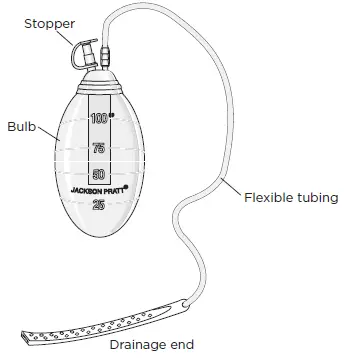
Two drains are typically placed. Each has a fenestrated tube (a tube with small holes) that sits at the surgical site and generally exits through a small gap in the lower abdominal incision, so no additional scar is needed. The tube has no holes beyond the skin level, which keeps suction at the surgical site. It connects to a bulb that is gently compressed before the stopper is inserted, creating the negative pressure that maintains suction (photo credit MSKCC).
Remove the stopper before measuring the fluid in the bulb, and record the amount on your drainage sheet. Empty the drains at roughly the same time every morning and evening so that 24-hour totals can be compared. Dr. Power will also ask you to note the colour of the fluid and any changes as you heal. Once the amount is recorded, empty the drain and re-insert the stopper while the bulb is compressed. This is important to maintain suction.
Drainage appears bloody over the first few days. It darkens over time as bleeding stops and old blood drains from the surgical site, then gradually changes to a clear yellow or pink-tinged fluid, known as serous drainage. The amount tapers as you heal.
Drains are removed once the output is appropriate; the first is usually removed within the first week, and the second generally within 10 to 14 days of surgery.
If drains are removed too early, there may be a higher risk of seroma formation. Almost all patients develop a small seroma after a tummy tuck if investigated with ultrasound. A small collection will likely resorb on its own and may not need treatment. A large or symptomatic seroma may be aspirated during a follow-up visit. If an infected seroma is suspected, drainage is urgently required, along with wound care as healing progresses.
If drains are left in too long, they may promote ongoing drainage and increase the risk of infection. Dr. Power closely monitors drain output and removes the drains as soon as it is medically appropriate. Prophylactic antibiotics may be prescribed while drains are in place, which will be discussed at your pre-operative visit.
Drain removal is done in the office during a routine post-operative appointment and takes only a few seconds. Local anesthetic is not required. The drain is taken off suction, the stitch that secures it is removed, and the tube is gently withdrawn. You may feel a pulling or pressure sensation, but there is generally no pain. Afterwards, place a gauze pad over the site for a day or so until the small opening closes.
Yes, you may take careful showers while the drains are in place, and you will be shown how before you go home. The drains may be secured to a loose loop of pantyhose tied around your waist while showering. Hold a washcloth over the drain sites as you gently wash your incisions with soap and running water.
Drains and the abdominal compression binder work together to lower the risk of fluid accumulation at the surgical site. The binder should be worn full-time for 6 weeks, even when sleeping, and removed only briefly to shower. It may also lower the risk of a late seroma after the drains have been removed. Read more about the abdominal binder after a tummy tuck and compression garments after surgery.
To learn more about our body contouring procedures, such as tummy tuck surgery, please contact Power Plastic Surgery in Toronto. During a consultation, Dr. Stephanie Power will assess whether a tummy tuck may help you achieve your goals.
Related Procedure: Curious if it’s right for you? Visit our tummy tuck with Dr. Power page for pricing and before/afters.

Life rarely slows down long enough to hand you a perfect window for surgery, but with thoughtful planning, that window
LEARN MORE
Breast augmentation can be a transformative procedure, but it’s not always a one-time decision. Whether you had your
LEARN MORE
Labiaplasty may be an effective procedure for addressing concerns regarding the size or symmetry of the labia. This procedure
LEARN MOREFill out the form below to schedule your consultation today.
Live far away? Contact us today to learn about lodging arrangements for out of town patients.
LEARN MOREWant to hear more from Dr. Power? Check out our blog for monthly updates and procedure information.
LEARN MOREWe are transparent about pricing. Just let us know which procedure you are interested in and we will give you a range!
LEARN MOREYou may learn more and book your elective
plastic surgery online. Click here to book a
time that is convenient for your busy schedule.
If you have further questions before booking,
please submit our intake form.