
 416-962-1010


Fly In For Surgery
Live far away? Contact us today to learn about lodging arrangements for out of town patients.
LEARN MORE
Posted on July 25, 2017 in General
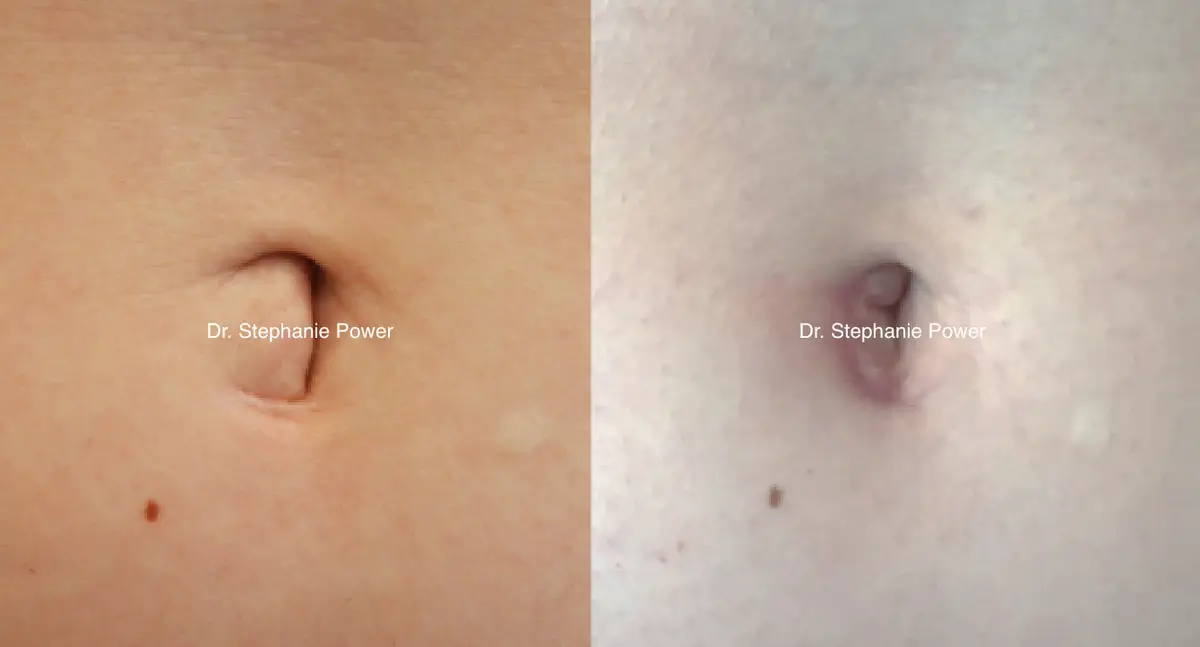
The belly button is an area of aesthetic concern for many patients. It often stretches after pregnancy, while other patients wish to remove a belly button piercing tract or reduce the prominence of a protruding (“outie”) belly button, and an umbilical hernia may also cause a bulge at the site. Umbilicoplasty is a minor plastic surgery procedure that changes the shape or appearance of the belly button. Here are five common questions from patients considering umbilicoplasty in Toronto with Dr. Stephanie Power.
Umbilicoplasty is a plastic surgery procedure that is performed to change the shape or appearance of the belly button. It may be performed alone or in combination with tummy tuck surgery.
If performed as an independent procedure, umbilicoplasty requires only local anesthetic in a minor procedure room setting. It may be performed to reduce the size of the belly button, to reduce protrusion, or to excise a piercing tract that is no longer desired. If combined with tummy tuck surgery, it is performed under general anesthetic. The size of the belly button is generally reduced through a circumferential incision. Permanent sutures are most commonly used, which are removed approximately 7-10 days post-operatively. If an umbilical hernia is present, the hernia may be reduced and repaired to correct bulging at the site.
As with most plastic surgery procedures, final results are achieved by one year post-operatively as scar maturation completes. Early results become apparent within a few months, however scars takes one year to fade and improve in appearance as long as protected from UV exposure during healing.
If umbilicoplasty alone is performed, patients may generally return to school or work the following day. Over-the-counter pain medication is recommended if any discomfort is experienced. Exercise should be avoided until a few weeks following umbilicoplasty to lower risk of bleeding and wound healing complications. If performed in combination with a tummy tuck or umbilical hernia repair, longer recovery will be required. Patients may return to office-based work within 1-2 weeks of surgery and exercise should be avoided until 6 weeks post-operatively given more extensive surgery.
It is important for patients to understand potential risks before proceeding with elective plastic surgery. Risks of umbilicoplasty include bleeding, infection, and delayed wound healing. Hypertrophic vs. keloid scarring may also occur. During consultation, Dr. Power will ask regarding risk factors for problematic scarring. If any concerns identified, they will be discussed in detail to enable you to make an informed decision before proceeding with elective surgery. Risks relating to aesthetic outcome include asymmetry, over- vs. undercorrection, and potential dissatisfaction with aesthetic outcome.
Umbilicoplasty is generally a well-tolerated minor plastic surgery procedure with low risk of complications in healthy patients who are non-smokers. It is a powerful technique that may change the size or appearance of the belly button. If considering this type of plastic surgery, Dr. Power will carefully listen to your aesthetic concerns and perform a detailed physical examination to assess whether umbilicoplasty may help you achieve your aesthetic goals.
These answers use details already published on this page. When a tummy tuck is part of the plan, read about tummy tuck surgery in Toronto.
Permanent sutures are most commonly used, and they are removed about 7 to 10 days after surgery.
Yes. Umbilicoplasty may be performed on its own or with a tummy tuck. On its own, it uses local anesthetic in a minor procedure room. When it is combined with tummy tuck surgery, it is performed under general anesthetic.
If an umbilical hernia is present, it may be reduced and repaired to correct bulging at the belly button. Recovery is longer when umbilicoplasty is combined with a tummy tuck or an umbilical hernia repair. Patients may return to office-based work within 1 to 2 weeks, and exercise is avoided until 6 weeks after that more extensive surgery.
The fee for umbilicoplasty is determined after your consultation, once Dr. Power has assessed your belly button and discussed whether it will be performed on its own or combined with a tummy tuck or hernia repair.
Please contact us if interested in scheduling a consultation with Dr. Stephanie Power, female plastic surgeon in Yorkville, Toronto.

Life rarely slows down long enough to hand you a perfect window for surgery, but with thoughtful planning, that window
LEARN MORE
Breast augmentation can be a transformative procedure, but it’s not always a one-time decision. Whether you had your
LEARN MORE
Labiaplasty may be an effective procedure for addressing concerns regarding the size or symmetry of the labia. This procedure
LEARN MOREFill out the form below to schedule your consultation today.
Live far away? Contact us today to learn about lodging arrangements for out of town patients.
LEARN MOREWant to hear more from Dr. Power? Check out our blog for monthly updates and procedure information.
LEARN MOREWe are transparent about pricing. Just let us know which procedure you are interested in and we will give you a range!
LEARN MOREYou may learn more and book your elective
plastic surgery online. Click here to book a
time that is convenient for your busy schedule.
If you have further questions before booking,
please submit our intake form.